
The InBody 970. Serious body composition analysis.
BodyIntel uses the InBody 970, a professional-grade body composition analyser using multi-frequency bioelectrical impedance analysis. The same class of equipment found in research facilities, sports science labs and elite performance environments.
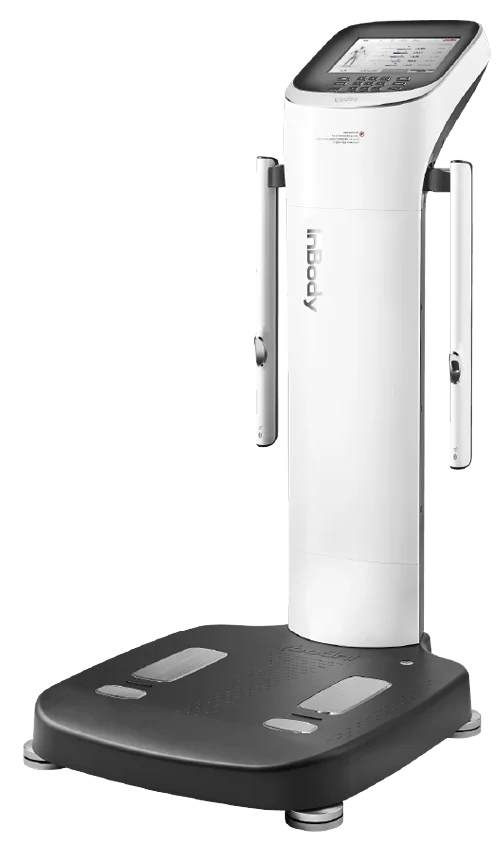
The InBody 970. Image courtesy of InBody Oceania.
Bioelectrical impedance analysis, explained simply.
BIA works by passing safe, low-level electrical currents through your body at multiple frequencies. Different tissues, muscle, fat and water, conduct electricity differently. The InBody 970 measures the resistance to these signals and uses it to calculate body composition.
It uses 6 frequencies and an 8-point electrode system across hands and feet to measure each body segment separately, giving a far more detailed picture than single-point or single-frequency devices. The result: a detailed breakdown of muscle mass, fat mass, body water and cellular metrics, without needles, radiation or any invasive procedure.
| Measurement method | 8-point multi-frequency BIA |
|---|---|
| Frequencies | 1, 5, 50, 250, 500, 1000 kHz |
| Electrode points | 8 (hands and feet) |
| Scan duration | Under 60 seconds |
| Segmental analysis | Arms, legs, trunk (separately) |
| Report output | Full result set in the InBody app |
Body composition scanning is an educational service. Results are not a medical assessment.
Multi-frequency measurement. More detail than standard scales.
Standard bathroom scales
- One number: weight only
- No muscle vs fat distinction
- No segmental analysis
- No hydration measurement
- No Phase Angle benchmark
- No composition change tracking
InBody 970 (BodyIntel)
- Skeletal muscle mass, total and by segment
- Body fat percentage and mass
- Arm, leg and trunk lean analysis separately
- Intracellular and extracellular water
- Phase Angle body composition benchmark
- Tracked over time on repeat scans
What is Phase Angle, and what does it actually measure?
Phase Angle is derived from the relationship between resistance and reactance in the BIA signal. In body composition terms, it reflects the integrity of the cell membrane, which is influenced by muscle mass, cellular hydration and overall body composition.
A higher Phase Angle is generally associated with greater muscle mass and better cellular hydration. Phase Angle is also studied in clinical research as an indicator of cellular health and nutritional status, which is part of why it is worth tracking. We use it as a body composition benchmark, tracked over time as a measure of how your composition is changing.
Illustrative example only. Phase Angle is a body composition benchmark only. It is not a clinical indicator, disease predictor, or medical assessment. Always consult a qualified health professional about your health.
How Phase Angle can be used
- As a body composition benchmark to track over time
- As a number to share with your coach, trainer or health professional
- As context alongside other body composition metrics in your report
What Phase Angle is not
- Not a clinical diagnostic or medical assessment
- Not a predictor of disease, lifespan or health outcomes
- Not a substitute for medical advice or clinical evaluation
See your own InBody 970 results.
Book a scan window at a venue near you.